ABOUT PROJECT
UCJC needed a clearer understanding of its student recruitment and enrollment process, from the moment a prospective student first considers university to the moment they complete matriculation. The project was conducted involving internal stakeholders, current students, alumni, and field observations at competing institutions. The goal was to map the as-is journey, identify friction points, and define a to-be journey grounded in real student motivations and expectations.
01. Challenge
How might we redesign the recruitment and enrollment experience at Universidad Camilo José Cela to better match the expectations and decision-making needs of prospective students, while helping internal teams work in a more coordinated and student-centered way?
The goal was to move from a fragmented, bureaucracy-heavy process toward a coherent service experience.
02. Core Problem
UCJC had a strong personal touch in human interactions, but this warmth wasn't translating into its digital presence, its information architecture, or its administrative processes. Prospective students couldn't find independent information about the university online, the website overwhelmed rather than informed, the campus visit lacked structure and follow-up, the admission test felt meaningless, and the enrollment process was so fragmented that students described it as a gymkhana. Meanwhile, internal departments weren't coordinated, creating friction at every handoff.
03. My Role
UX Researcher & Service Designer
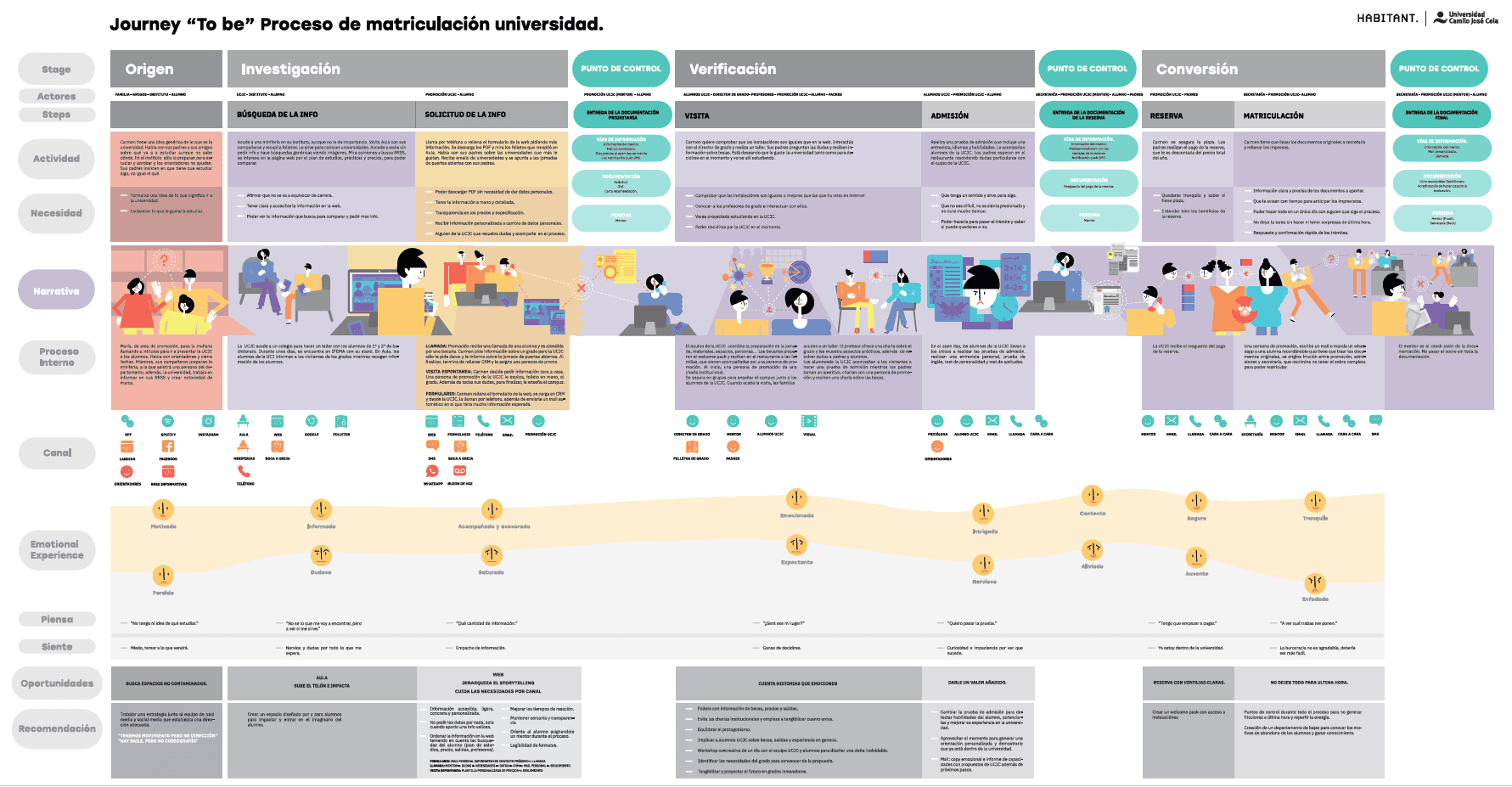
I led the research and strategic framing across the full project lifecycle, working alongside another researcher and a UX/UI designer within the Habitant team. This included facilitating and conducting 12 in-depth interviews with internal university profiles and students, coordinating 2 focus groups with first-year students, conducting participatory observation across 6 university visits including competitor campuses, running 2 co-creation workshops with the UCJC team, mapping the as-is student journey across four stages (Origin, Research, Verification, Conversion), defining strategic and tactical findings, producing the to-be journey map, analyzing the degree page UX, and formulating 10 strategic design principles to guide future decisions.
04. Impact
The engagement delivered a shared foundation for transforming the student experience:
Full journey visibility Produced a comprehensive to-be journey map covering all four stages with activity, emotional experience, channels, internal process, and opportunity areas for each step.
Strategical and tactical findings Separated high-level findings (brand perception, self-image, digital presence) from tactical ones (website saturation, visit structure, reservation invisibility, enrollment friction), allowing UCJC to prioritize and sequence improvements.
Design principles Defined 10 actionable principles to guide future decisions across the entire recruitment funnel, from hyper-personalization and incremental trust-building to making the campus visit an experience rather than a walkthrough.
UX audit Delivered a structured analysis of the existing degree page with specific recommendations on imagery, content hierarchy, information priorities, testimonials, data exchange ethics, and calls to action.
05. Takeaways
Warmth doesn't travel automatically What works face-to-face doesn't translate into digital or administrative processes on its own. Closing that gap requires deliberate service design across every touchpoint.
The visit is the moment of truth More than any digital asset, the campus visit was where students made their decision. Structuring it as a designed experience, not as an informal tour, has an outsized return on conversion.
Coordination is a design problem Many of the frictions students experienced weren't caused by bad intentions but by departments working in silos. Showing the internal team what students actually went through was the most valuable intervention.
06. Research & Framing
The work was structured around three interconnected objectives: empathize with internal departments to understand the university ecosystem and map the as-is journey; discover student motivations, friction points, and decision drivers; and clarify opportunities to build the to-be journey. Research combined in-depth interviews with internal and external stakeholders, focus groups with first-year students, participatory observation at UCJC and four competitor institutions, field research, and two co-creation and validation workshops. Findings were organized across four journey stages: Origin, Research, Verification, and Conversion, each with its own rhythm, actors, and friction points.
07. Key Insights
Students want context they can trust Prospective students actively searched for information that didn't come from the university itself. The near-total absence of independent online content created a credibility gap the open day alone couldn't fill.
The website overwhelms instead of informs Students found degree pages saturated with content that didn't answer their real questions: curriculum, prices, career outcomes, faculty, scholarships. Too much noise, not enough signal.
Enrollment feels like a survival test Both students and internal staff described the matriculation process as chaotic, informal, poorly coordinated, and incomplete. A process meant to welcome students was leaving them with a bad taste at the finish line.